What Does OpenCode Store Locally? opencode.db Explained
OpenCode stores sessions, messages, and tool parts in SQLite—not JSONL. Here's the schema, the subagent rows, the compaction trap, and how to read it safely.
OpenCode looks like a chat interface, but its local history is closer to an application database.
That matters the first time you try to answer a simple question such as “show me the session where the agent changed the router.” There is no canonical transcript file to open. The answer is distributed across a session row, message rows, and part rows inside SQLite.
The useful mental model is:
session row   → identity, title, project, parent_id, timestamps, model JSON, cost
message rows  → user/assistant boundaries and message metadata
part rows     → text, reasoning, tools, step markers, files, compaction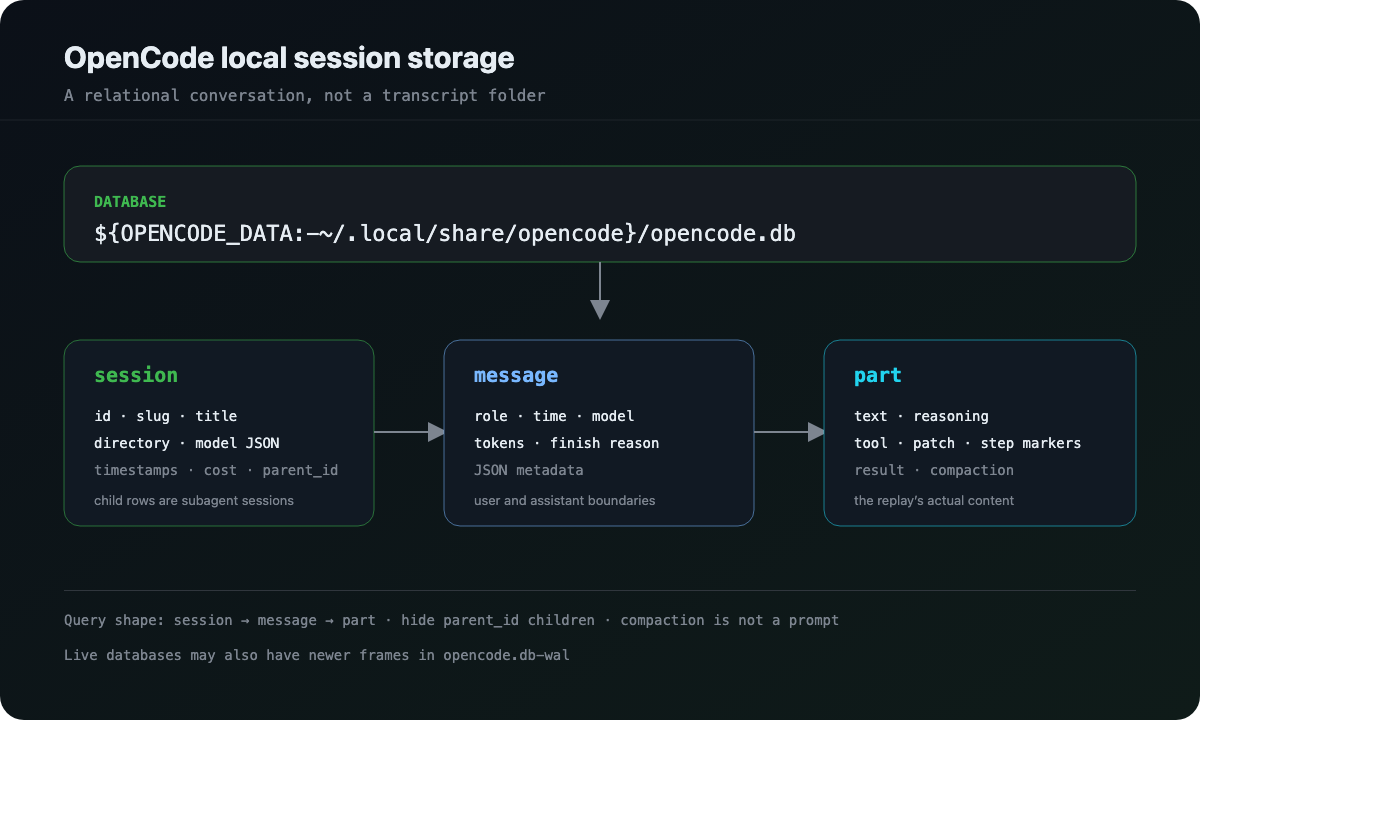
vibe-replay treats those rows as one logical conversation and turns them into the same replay vocabulary used for Claude Code, Cursor, Codex, Hermes, and Pi.
Where does OpenCode store its database?
On macOS and Linux, OpenCode normally uses:
~/.local/share/opencode/opencode.dbOn Windows, the default follows %LOCALAPPDATA%\opencode\opencode.db. OPENCODE_DATA overrides the data directory on every platform. On macOS and Linux, XDG_DATA_HOME can move the whole XDG data root, so the default is ${XDG_DATA_HOME:-$HOME/.local/share}/opencode.
The portable way to locate the database on macOS and Linux is:
echo "${OPENCODE_DATA:-${XDG_DATA_HOME:-$HOME/.local/share}/opencode}/opencode.db"On Windows, use %OPENCODE_DATA%\opencode.db when that variable is set, otherwise %LOCALAPPDATA%\opencode\opencode.db. The Bash snippets below are for Unix shells.
The variable names and schema are implementation details of the local OpenCode build. A future release may add columns or reshape JSON payloads without changing the fact that the database is the source of truth.
If SQLite is installed, a quick inventory is:
sqlite3 "${OPENCODE_DATA:-${XDG_DATA_HOME:-$HOME/.local/share}/opencode}/opencode.db" \
  '.tables'
The tables that matter for replay are usually session, message, and part. Some versions also carry project or auxiliary tables.
Why are sessions, messages, and parts separate?
OpenCode has a relational conversation model. A session is the container; messages establish roles and timestamps; parts hold the content that makes a message interesting.
A simplified shape looks like this:
session(id, parent_id, slug, title, directory, time_created, time_updated, model, cost)
  └── message(id, session_id, data)
        └── part(id, message_id, session_id, data)
The data columns are JSON rather than a single normalized column for every possible event. That lets OpenCode add a new part type without a database migration for every UI feature, but it means a reader must validate JSON and branch on type.
model is not a plain string. Current builds store JSON such as {"id":"…","providerID":"opencode"}. Selecting the column as if it were the model name will print the whole object.
Typical message metadata includes:
role: user or assistant;- created and completed timestamps;
- model id;
- token usage and cache fields;
- finish reason.
Typical parts include:
textandreasoning;toolcalls and their state;patchandfile;compactionmarkers;step-start/step-finishstreaming markers.
Those last two are usually the most numerous part types. They are not prompts, tools, or results. Counting every part as content inflates activity; counting only tool parts gives tool-call volume, and counting user text parts (minus compaction) gives prompts.
Child sessions are not top-level conversations
OpenCode stores subagent work as extra session rows with parent_id set. The titles look like conversations — Explore repo structure (@explore subagent) — but they belong to a parent session, not the picker.
A catalog query that does SELECT * FROM session therefore lists children next to their parents. vibe-replay keeps those child rows out of discovery when the column exists:
SELECT id, slug, title, directory
FROM session
WHERE parent_id IS NULL;
Older databases may not have parent_id. In that case the filter has to disappear rather than fail with no such column. The child row is still parseable if you already have its id; it just should not appear as its own card in a session list.
The compaction trap: not every user-looking row is a prompt
OpenCode writes context compaction as a synthetic user message with a compaction part. Current builds often store that part alone. Older or mixed messages can also carry text on the same row.
If you count every role = 'user' message, the compaction summary becomes an extra human prompt. The dashboard then reports too many turns, and the first-prompt preview can become a summary instead of something the user typed.
The safe query shape is closer to:
SELECT m.session_id, COUNT(DISTINCT m.id)
FROM part p
JOIN message m ON m.id = p.message_id
WHERE json_extract(m.data, '$.role') = 'user'
  AND json_extract(p.data, '$.type') = 'text'
  AND NOT EXISTS (
    SELECT 1
    FROM part compact
    WHERE compact.message_id = m.id
      AND json_extract(compact.data, '$.type') = 'compaction'
  )
GROUP BY m.session_id;
Real databases need an additional guard around malformed JSON. json_valid(data) keeps a damaged or partially-written row from taking down the whole discovery pass.
Compaction is not lost just because it is excluded from prompt counts. vibe-replay keeps it as a distinct replay event so you can see where context was summarized and how the conversation continued.
Why schema drift is normal here
OpenCode has changed the session table over time. Fields such as agent, model, cost, and token columns may be absent in an older database or named differently in a newer one.
A brittle reader does this:
SELECT id, title, agent, model, cost, tokens_input
FROM session;
That query is fine until one optional column is missing. A resilient reader first asks SQLite what exists:
PRAGMA table_info(session);Then it builds a projection from the columns that are actually present. Missing model or cost metadata should lower the quality of one metric, not make every session disappear.
This is a general lesson for local AI-agent storage: the database is real, but it is not necessarily a stable public API. Version-tolerant discovery is part of replay correctness.
Where do costs and tokens come from?
Some OpenCode versions persist session-level cost and token fields. Assistant message JSON can also contain per-message usage, including cached input and output. Those values have different scopes:
session.costis a provider-reported total, but the column is oftenNOT NULLwith a stored0.0;- free or unbilled models commonly keep that zero even after millions of input tokens;
- message usage is attached to an assistant response;
- a stored zero is closer to “not billed / not recorded” than to a reconstructed $0.00 invoice.
vibe-replay preserves provider-reported cost only when it is positive, and it keeps token categories separate. It does not treat cost = 0 as a bill, and it does not add a session total to per-message totals.
The same principle applies to timing. OpenCode has message timestamps, but idle gaps are not necessarily active model time. A replay can show the timeline while labeling reconstructed duration as an estimate.
The WAL problem: why a live session may be invisible
SQLite can write recent changes to a write-ahead log next to the main database:
opencode.db
opencode.db-wal
opencode.db-shm
If a process has not checkpointed those frames into opencode.db, a reader that opens only the main file may not see the newest session. This is particularly relevant while OpenCode is running for a long time.
A tool should not copy or mutate the live database just to chase those rows. It should report the limitation, retry when the database is checkpointed, or use a provider-supported read path. vibe-replay keeps SQLite reads read-only and uses a lightweight discovery path for database-backed sessions so a large database is not opened once per dashboard card.
How vibe-replay reads OpenCode
Discovery reads the session table, skips child rows when parent_id is present, and joins aggregate counts from message and part. Each discovered session gets a marker path in this form:
<database-path>#session:<session-id>That is not a file that OpenCode creates. It is a replay-tool pointer that preserves which database and which session should be parsed later.
When you open a replay, the provider:
- resolves the session id from the marker;
- opens the hinted SQLite database with a portable read-only reader;
- reads messages in timestamp order;
- expands parts into text, reasoning, tool calls, results, images, and compaction events, skipping
step-start/step-finish; - maps provider-specific tool names into the shared viewer vocabulary;
- records parse warnings instead of hiding malformed rows.
That gives OpenCode sessions the same useful output as a JSONL provider without pretending the underlying storage is JSONL.
A safe way to inspect OpenCode history
Start with metadata, not a full dump:
DB="${OPENCODE_DATA:-${XDG_DATA_HOME:-$HOME/.local/share}/opencode}/opencode.db"
sqlite3 "$DB" \
  'select id, title, directory, parent_id,
          datetime(time_updated/1000, "unixepoch")
   from session
   where parent_id is null
   order by time_updated desc limit 10;'
If parent_id is missing, drop that column and the where clause. That is the schema-drift case above, not a broken install.
Do not paste the result into a public issue without checking it. Titles, directories, prompts, tool arguments, and file contents can all be sensitive. Generate a reviewed replay instead of sharing the database.
If Claude Code’s one-file JSONL model is the simple case, OpenCode is the database case: structured, queryable, and more version-sensitive. Once you follow the session → message → part chain, the storage stops looking mysterious — and the replay can preserve the details that a flat session list leaves out.
For the same storage question in other providers, compare the profile-aware Hermes state.db and the branch-aware Pi session JSONL layouts.